Rebuilding Finomial's Product Infrastructure
B2B
Web app
Finomial is a global portfolio management and analytics platform serving portfolio managers, advisors, and fund distributors.

Due to NDA restrictions, I can't share all the original design details and artifacts from this project. However, if you're interested in learning more about my experience at this project, feel free to reach out!
My role
As the sole product designer, I rebuilt the product's foundation and core workflows from scratch, transforming a fragmented tool into a cohesive, workflow-driven system.
Context
When I joined, the product was functional but chaotic. Twelve button types. No design system. No handoff process. Features took months to ship. Users were getting work done despite the tools, not because of them.
Building the foundation
The product had no component library, no documentation, no shared design language. I built a design system from scratch as the foundation. Created a comprehensive Figma library with component documentation.
Introduced Design Requirement Documents (DRDs) so the team understood not just what we were building, but why. Feature delivery went from months to weeks. QA cycles shrank. The founder started reading DRDs before prioritizing work.
Fund Explorer
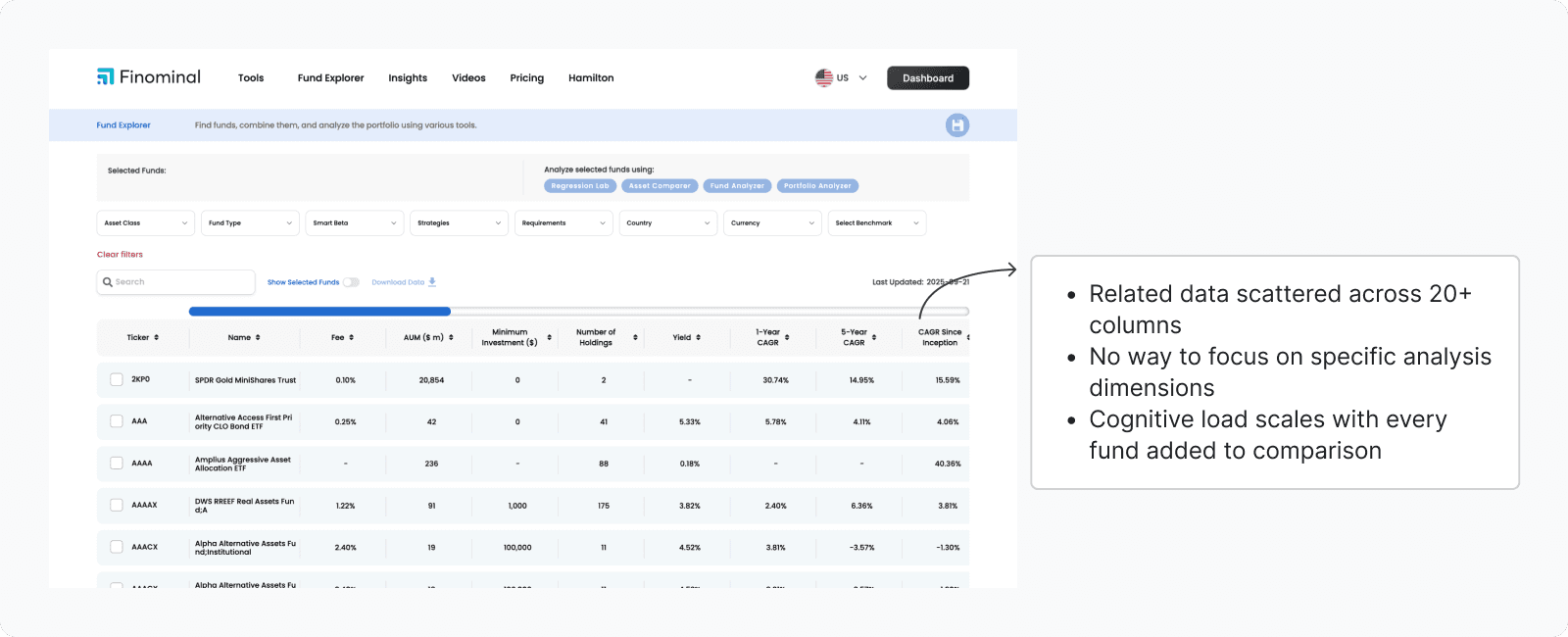
With 200,000+ funds in the system, the explorer was built like a database dump. Portfolio managers had to scroll through 20+ columns, memorize positions, and hunt for scattered data every time they compared funds.


Performance Dashboard
Portfolio managers were navigating into individual detail pages repeatedly just to check performance. No way to compare portfolios at a glance. I added a Performance tab to the dashboard. All portfolio performance visible at once. Built-in comparison. Zero navigation required.
Workflow went from 15+ clicks to 2. Usage shifted immediately. Leads called it out in product demos.


Others


Key principles
1
Observe workflows, don't ask for features
2
Build systems, not features
3
Documentation creates shared vision
4
Match the tool to the workflow, not the database
Impact
Feature delivery time dropped from weeks to days. Support tickets decreased noticeably as component behavior became predictable and documented.
Learnings
Joining as the sole designer meant building everything systems, features, processes, alignment. The biggest shift wasn't learning a new design pattern. It was understanding that design work scales through infrastructure.
Writing down the "why" behind features forced clarity. It surfaced assumptions. It prevented rework. The work improved not because the designs were better, but because everyone understood what we were solving for.
Working in B2B taught me that user empathy isn't about emotional resonance it's about respecting how people actually work.


