From minutes to seconds: How I slashed trading time by 80% for Professional Traders
B2B
Web app
InvestIT is an AI-powered automated trading platform that bridges the gap between investors who want to grow their money and expert traders who have the skills to make it happen.

Due to NDA restrictions, I can't share all the original design details and artifacts from this project. However, if you're interested in learning more about my experience at this project, feel free to reach out!
My role
As the sole designer for this project, my responsibilities include working closely with stakeholders to synthesis user requirements, prioritizing outcomes, leading the end-to-end design process, and managing expectations across dev teams.
The challenge
I observed that dealers (professional traders) often struggle with a tedious order placement process. Dealers were constantly switching between tabs, trying to place identical orders across different client accounts.
This leads not just frustration, but also slowing down the order execution that negatively affects the business as each seconds counts in the market
The problem was clear: Dealers needed a way to execute trades quickly across multiple client accounts without compromising accuracy.
Identifying core issues
To get a deeper understanding of the challenge, I followed a structured approach to uncover the core issues. Below are the key steps I took as part of the problem discovery process.
Analyzing the current workflow: Mapped the existing order placing flow form selecting stock to identify inefficiencies and bottlenecks.
User interviews: Conducted interviews with 3 dealers to pinpoint time-consuming steps and areas prone to errors.
Analyzing the current workflow
I shadowed dealers during their trading hours, mapping out their process:

User research
I conducted in-depth interviews with 3 key dealers, asking questions like:
Can you take me through the process of placing orders?
Do you remember how long it took to place a order?
What are the struggles and frustrations when you place order?
What are the workarounds when you encounter any blockers?
Synthesizing data
I conducted an affinity mapping exercise to categorize and synthesize data from user interviews. This process enabled me to identify patterns, themes, and key insights from the sessions.
1
90% struggled with the current multi-tab approach
2
80% wanted a streamlined order placement process
3
60% had difficulty accessing client information quickly
4
Average order placement took 2-3 minutes per client
Redefining the problem
How might we....
Reduce errors and time consumption in the order placing process while providing better guidance to enhance the user experience
Creating new workflow
Before diving into solutions, I established key principles to guide my design:
1
Enable rapid order execution across multiple accounts without compromising accuracy
2
Provide instant visibility of crucial client information to support confident decision-making
3
Minimize cognitive load by displaying relevant information upfront
4
Create a seamless flow that eliminates tab switching and repetitive actions
The solution
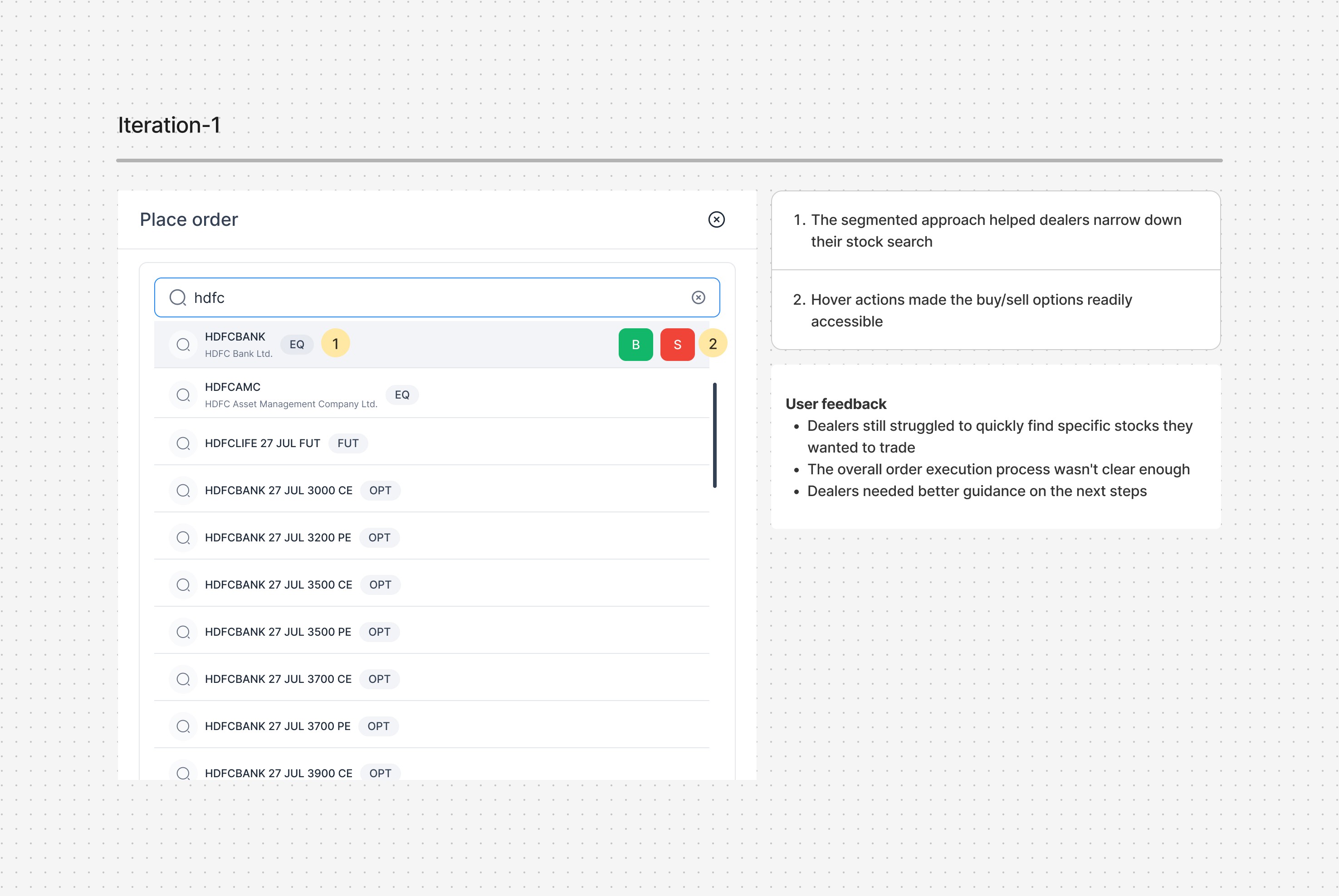
Step-1: Smart stock selection
My first challenge was to help dealers find and select stocks efficiently. Dealers needed a system that could handle thousands of stocks while making the search process effortless.

Step 2: Streamlining order details
The challenge was clear: create an order entry system that's comprehensive, efficient and optimized.


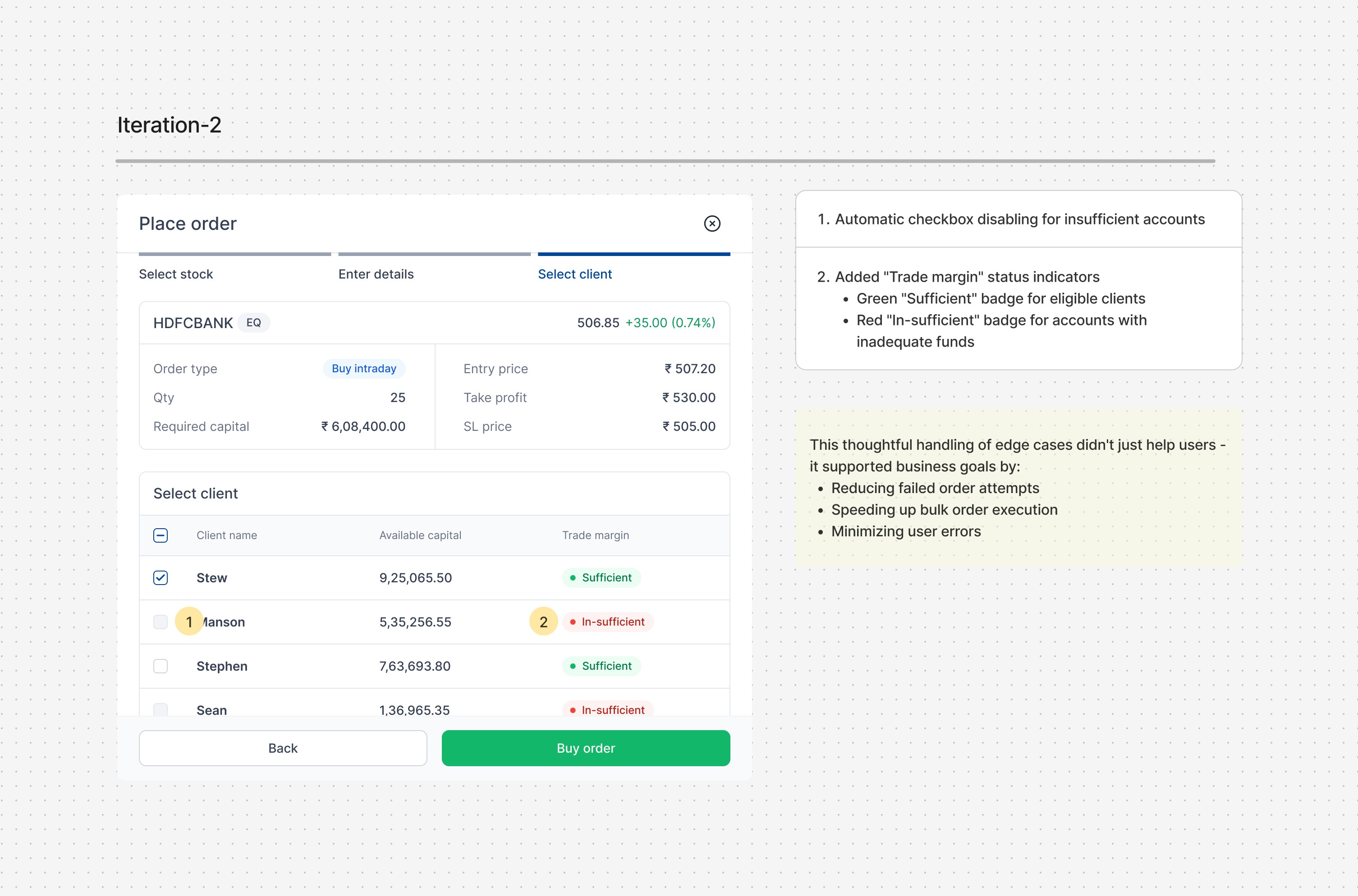
Step 3: Making client selection efficient
The challenge was to transform what was once a time-consuming process of checking individual client balances into a seamless experience.

Impact
The transformation was immediate. Dealers could now execute orders for multiple clients in the time it used to take for just one. The new system reduced order placement time from 3-5 minutes to under 30 seconds for multiple clients.
Learnings
Solving one focused problem exceptionally well can have more impact than trying to fix everything at once - our multi-order system proved this by dramatically reducing trade execution time. Most importantly, we learned that great design often comes from watching what users do rather than just listening to what they say they need.


